
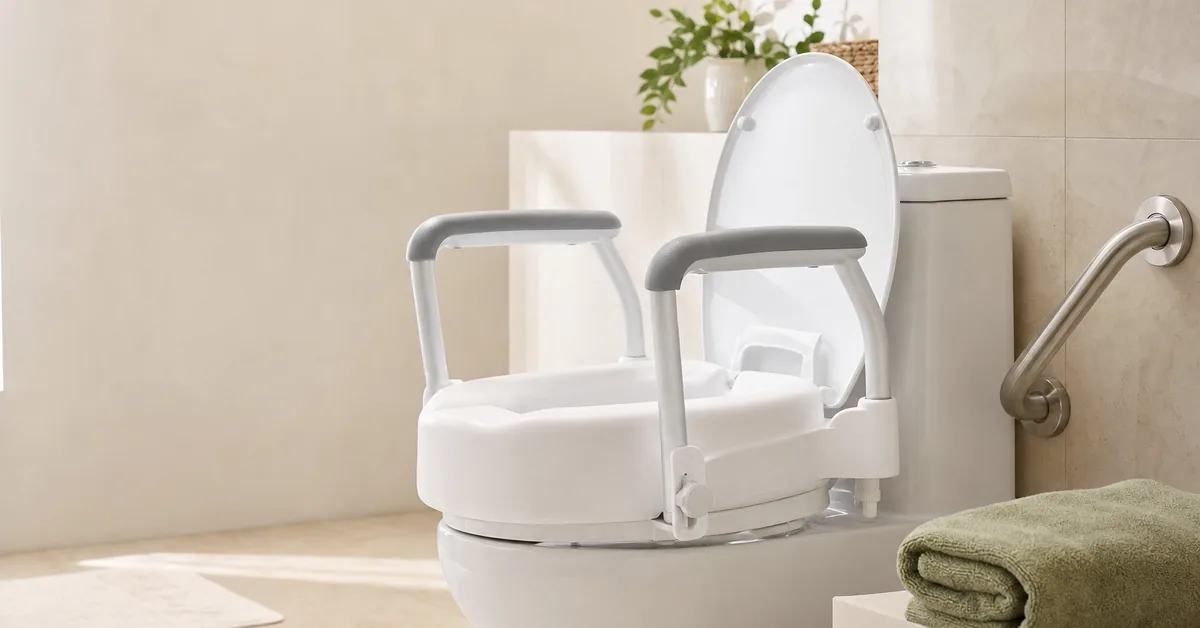
A raised toilet seat adds 3 to 5 inches so sitting and standing take less strain. How to choose height, locking, and fit, and what Medicare will and will not cover.
A raised toilet seat, also called a toilet riser, adds 3 to 5 inches of height to a standard toilet, so sitting down and standing up take less strain on the hips, knees, and back. It is one of the simplest and cheapest safety upgrades in a senior bathroom. This guide covers the types, how to choose height, locking, and fit, and the coverage question most buyers get wrong.
Raised toilet seat vs. comfort-height toilet vs. commode
Three different fixes solve the problem of a toilet that sits too low. They are easy to confuse.
- Raised toilet seat or riser, which is what this guide covers: an attachment that clamps onto the toilet you already have. It is the cheapest option, it needs no plumbing, and it comes off again.
- Comfort-height toilet: a taller toilet that replaces the old one. It is permanent, and it costs more. See my comfort-height toilet review.
- Three-in-one commode: a chair that can also sit over the toilet as a raised seat with arms.
For the wider picture, see the full bathroom safety guide.
Types of raised toilet seats
| Type | Best for | Notes |
|---|---|---|
| Clamp-on riser, no arms | A simple height boost | Lowest cost; choose a locking clamp |
| Riser with arms or handles | A weaker upper body that needs push-up support | Makes sit-to-stand easier |
| Hinged or fold-back riser | A household sharing one toilet | Lifts away so others can use the toilet normally |
| Locking vs. friction-fit | Safety | A locking bracket will not slide, and is strongly preferred |
| Elongated vs. round | Fit | Must match the shape of your toilet bowl |
How to choose
- Height added: most add 3 to 5 inches. Higher is not always better, because the feet should still reach the floor for stability.
- Locking mechanism: choose a model that bolts or clamps securely. Avoid a seat that rests by friction alone, because it can shift.
- Bowl shape: confirm round or elongated to match the toilet.
- Weight capacity: check the rating, and choose a bariatric model if one is needed.
- Arms and handles: add them if standing is hard. Some are removable.
- Cleaning: a smooth design with no gaps is more hygienic and easier to wipe down.
My pick from the catalog is the Vive Raised Toilet Seat with Arms, which adds height and padded arms for an easier sit-to-stand. If the toilet is already tall enough and only the standing is hard, the Vive Toilet Safety Rail with Arms adds arms without adding height.
Does Medicare cover a raised toilet seat?
No. Original Medicare does not cover raised toilet seats. Medicare classifies them as comfort or convenience items rather than durable medical equipment, so Part A and Part B will not pay for them (AARP, retrieved 2026-09-12).
A bedside commode is different. It is covered as durable medical equipment when a doctor prescribes it (Medicare.gov, retrieved 2026-09-12). If you need both extra height and a toilet that stands on its own, a prescribed three-in-one commode may be the covered route.
Ways to lower the cost
- Medicare Advantage: some plans include an allowance, often up to about $500 a year, for bathroom safety devices. Check your own plan.
- Medicaid HCBS waivers, VA grants, and local nonprofit programs may cover part of the cost.
- Tax deduction: a home modification that is medically necessary may be deductible. Ask a tax professional.
See also the related guide on what Medicare covers for mobility aids.
Key Takeaways
- A raised toilet seat adds 3 to 5 inches, so rising and lowering are safer. That matters most after hip or knee surgery.
- A locking model will not shift under you. Choose a secure clamp over a simple friction fit.
- Match the shape, round or elongated, to your toilet bowl, and check the weight capacity.
- A model with padded arms adds push-up support for a weaker upper body.
- Original Medicare does not cover raised toilet seats. Some Medicare Advantage plans may help.
Sources
- AARP — Does Medicare Cover Home Safety Equipment? (retrieved 2026-09-12)
- Medicare.gov — Commode chairs coverage (retrieved 2026-09-12)
This article is general information, not medical or financial advice. Coverage depends on your own plan. To confirm anything that matters to you, check Medicare.gov, call 1-800-MEDICARE, or contact your plan directly.