
Why does standing up from a chair feel riskier than walking for many seniors?
Walking gives a steady rhythm and momentum; standing up from a seated position asks the legs and core to generate force from a dead stop, which is exactly when balance most often fails. A cane cannot safely do that work, and Cleveland Clinic advises pushing up from the arm of the chair instead. What a self-standing cane can do is wait beside the seat, so it is in hand for the first unsteady steps.
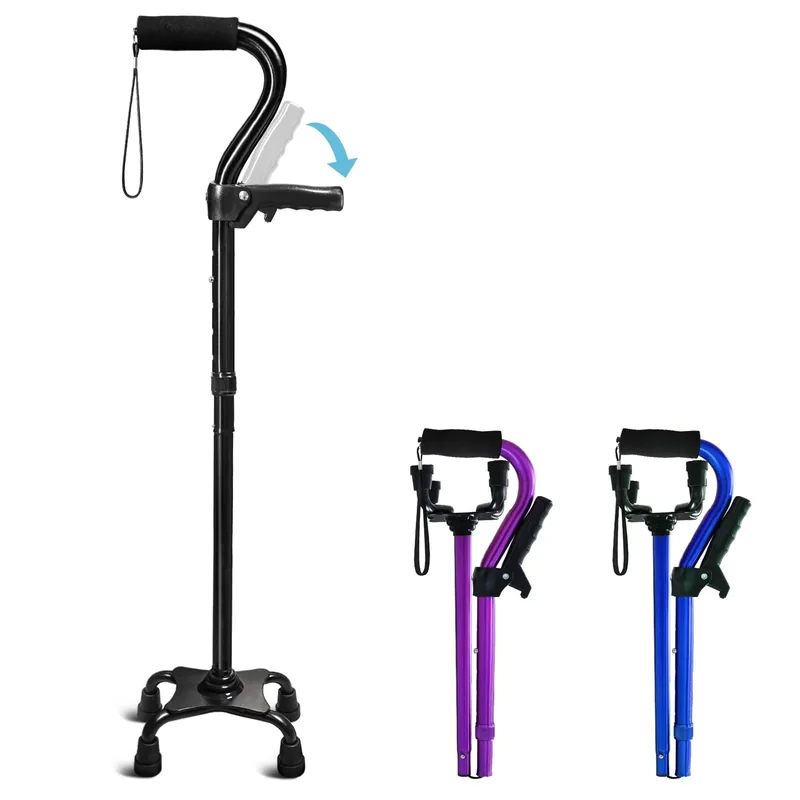
KingPavonini 4-Prong Adjustable Cane
A folding quad-base cane with a foam offset handle and a second, lower handle — adjustable from 32 to 37.5 inches and rated by its maker to 300 lb.
Key Features
- A four-point base holds the cane upright on its own, spreading weight across four contact points rather than a single tip
- The maker adds the lower grip for rising from a low seat; Cleveland Clinic advises against using any cane that way, so push up from the chair arm first
- Foam padding distributes grip pressure more evenly than a thin standard cane handle
Best for
Seniors who feel unsteady in the first steps after rising from a chair and want a cane that stands ready beside the seat
A practical everyday-safety gift for a parent who has started to feel wobbly on their feet.
Worth knowing
The wider four-point base needs more floor clearance than a standard cane — narrow hallways or tight furniture spacing may make it awkward to maneuver. Foam handle grip should be checked periodically for wear.
I may earn a commission at no extra cost to you.
Are quad canes worth it for seniors?
Balance loss most often happens at transition moments — rising from a seat, catching a curb, turning quickly — rather than during a steady walking stride. A cane built only for the latter offers little help at the moment balance actually fails.
Treat the extra grip as a steadying point once you are up, not as something to haul yourself up on. Cleveland Clinic warns that the weight balance of a cane is not reliable for sitting down or standing up. For walking, this one gives more support than a basic cane, with less bulk than a rollator or walker.
Frequently Asked Questions
The maker adds it for standing up from a low seat. Cleveland Clinic advises against using a cane to sit down or stand up, because the weight balance is not reliable. Push up from the arm of the chair, then take hold of the cane.
It can — the four-point base needs more floor clearance than a standard cane, so narrow hallways or tight furniture spacing may make it a bit awkward to maneuver.
Yes — the four-point base holds it upright on its own, spreading weight across four contact points rather than a single tip.
Where this information comes from
The factual, health, and safety claims on this page draw on these primary, authoritative sources.
- How To Use a Cane — Cleveland Clinic
How does it compare?
Other options in this category worth considering.
| Product | Price | Best for |
|---|---|---|
| KingPavonini 4-Prong Adjustable Cane This pick | $35–$35 | Seniors who feel unsteady in the first steps after rising from a chair and want a cane that stands ready beside the seat | A practical everyday-safety gift for a parent who has started to feel wobbly on their feet. |
| COLAMY Home — Ergonomic Chairs & Power Lift Recliners | $100–$400 | Seniors furnishing or refreshing their home who want functional seating — a lift recliner or a dining chair with better support — without the clinical appearance of standard adaptive equipment | Adult children whose parent struggles with a low sofa or an unsupportive dining chair, and who want a practical gift that belongs in the living room. |
| LIXIANG Elegant Folding Cane | $25–$30 | Women who've been advised to use a cane but have avoided it because standard designs feel too institutional | A confidence-building gift for a parent who needs balance support but has resisted carrying a cane that looks overtly medical. |
Prices are approximate ranges — check each retailer for today's price.
More in this category
Browse Elegant Mobility & Active LifestyleLast updated: .