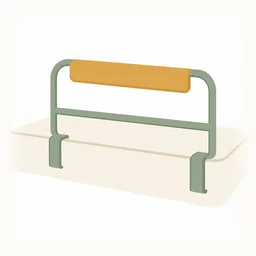
Bed rails, clinical adjustable beds, and cushioned bedside mats that make getting in and out of bed safe and independent.
A bed rail can help a senior turn over and get in and out of bed safely — but adult portable bed rails also carry a real, well-documented risk: entrapment. From January 2003 through December 2021 the U.S. Consumer Product Safety Commission identified 310 fatal incidents involving adult portable bed rails, and 284 of them (92%) involved rail entrapment (CPSC proposed rule, 87 FR 67586, retrieved 2026-09-15; the CPSC safety alert of November 14, 2024 reports the same 92% entrapment share, nine recalls in three years, and 18 deaths reported since 2021). Choosing the right type, fitting it correctly, and knowing who should not use one matters more than the price.
This is general information, not medical advice. For anyone with confusion, dementia, or restricted movement, have a doctor or occupational therapist assess bed-rail safety first — and check cpsc.gov/Recalls before buying.
Adult portable bed rail deaths by cause
310 reported deaths, 2003 to 2021
Entrapment92%
Other causes8%
Adult portable bed rail deaths and entrapment share, 2003 to 2021. Source: CPSC proposed rule, 87 FR 67586 (2022).
The two types of bed rails
Type
What it is
Risk & coverage
Portable / assist rails (consumer)
Attach to a normal bed; includes single bed-assist handles and longer barrier rails
Higher entrapment risk; now under the 2023 CPSC standard
Hospital-bed (integrated) rails
Built for a hospital bed; come in half-length and full-length
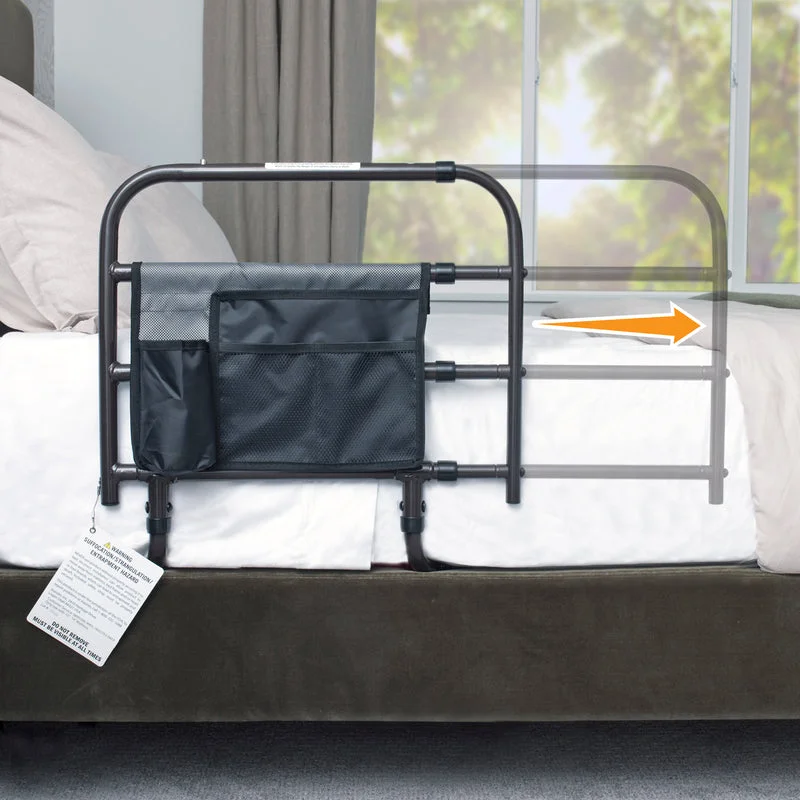
Bed rail with an adjustable length that doubles as a padded stand-assist handle; straps to a traditional bed with a 10 to 14 inch mattress.
Key features
Rail length adjusts from 20 to 30 inches, so the same unit serves as a short push-up handle or a longer rail along the mattress edge
Secures to the bed frame with the included safety strap — the retention strap CPSC tells buyers to check is part of the design
Rated to 300 lb and passed the ASTM F3186-17 standard for adult portable bed rails
Foam-padded non-slip handle with a multi-pocket organizer pouch for glasses, phone, and remotes
Best for
Seniors who have started rocking to build momentum before standing, or bracing on a bedside table that was never built to take weight, and who can reliably position themselves in bed. | A practical gift after a parent’s surgery — it straps to the frame and comes off again once it is no longer needed.
Worth knowing
Portable rails carry an entrapment risk: the CPSC and FDA warn that a person can slide between the rail and the mattress. Fit the safety strap, press the rail firmly against the mattress, keep at least 12.5 inches between the rail and the headboard or footboard, and check cpsc.gov/Recalls before buying. The FDA says portable rails can be a hazard for people with altered mental status such as dementia or delirium, so get a professional assessment first in that case. Not compatible with adjustable-base beds.
High-density foam bedside mat that cushions nighttime floor contact and reduces injury severity in a fall, with a non-slip base.
Key features
High-density memory foam cushioning
Non-slip backing on all floor types
Low profile for under-bed storage
Machine washable cover
Bundle with bed rails and night lights
Best for
Seniors with nighttime mobility concerns or a history of falls — memory foam cushions any missed step getting out of bed, placed flat beside the mattress. | A practical safety gift for a parent post-surgery or with a fall history — unbox, place beside the bed, works immediately with no installation.
Worth knowing
Injury mitigation, not prevention — a companion to bed rails and motion-activated night lighting, not a replacement for them.
Per the FDA, portable bed rails are assistive devices, not restraints, and they are not appropriate for everyone (FDA). Get a professional assessment first if the person has dementia, delirium, or confusion; is restless or tends to climb over rails; or cannot reliably reposition the rail themselves. A single bed-assist handle is generally lower-risk than a full barrier rail because it does not create long enclosed gaps.
Safer alternatives — and what to buy
If the goal is preventing falls or helping someone in and out of bed, clinicians and the FDA point to options that avoid entrapment risk: lowering the bed, a fall mat beside it, a bed-exit alarm, a bed-assist handle instead of a full rail, and addressing the reason for getting up. From the catalog, the Stander EZ Adjust bed rail (a portable rail tested to the ASTM F3186-17 standard that extends from 20 to 30 inches; at its shortest it works as a stand-assist handle, but it is still a portable rail, so the strap, gap, and assessment precautions above apply) pairs well with the Vive bedside fall mat as a floor-level backup.
Frequently Asked Questions
Motion-activated night lights between bedroom and bathroom eliminate dangerous dark paths. Bed rails or assist handles help with getting in and out of bed safely. Keeping frequently needed items — glasses, water, phone — within reach of the bed without requiring stretching reduces midnight hazards. Securing any loose rugs or removing them entirely is also essential.
The ideal bed height allows your feet to touch the floor flat when sitting on the edge, with your hips and knees at about 90 degrees. A bed that is too high requires jumping down (fall risk); too low makes standing difficult. Adjustable bed frames, mattress toppers, or bed risers can bring most beds into the ideal range.
Bed exit alarms can alert caregivers when someone at fall risk or with dementia gets up unassisted. They are most useful in care settings or homes where a caregiver is nearby and can respond quickly. They are less effective when a caregiver is not immediately available to help.
Motion-activated LED night lights placed low on the wall (6–12 inches from the floor) provide safe path lighting without causing light-sensitive waking. Smart bulbs that can be voice-controlled from bed eliminate the need to reach for switches in the dark. Ensure the bedroom light switch is easy to locate near the door.
Content on this page is for informational purposes only and does not constitute medical advice. Adult portable bed rails carry an entrapment risk; anyone with dementia, delirium, or restricted movement should be assessed by a doctor or occupational therapist before a rail is used. Check cpsc.gov/Recalls before buying.