

Long-haul flights change as you age. Here's what experienced older travelers have learned — about cabins, airports, health, and the difference it makes.
The experience of a long-haul flight changes with age in ways that are worth understanding before the ticket is booked. The core challenge — twelve or more hours in a pressurised, dry, relatively inactive environment — has effects that are more pronounced in older bodies: dehydration from recirculated air, the circulatory effects of prolonged immobility, and circadian disruption that takes longer to recover from. Experienced older long-haul travelers have generally developed approaches to managing these effects that make the journey significantly more manageable.
Cabin class: what you actually get
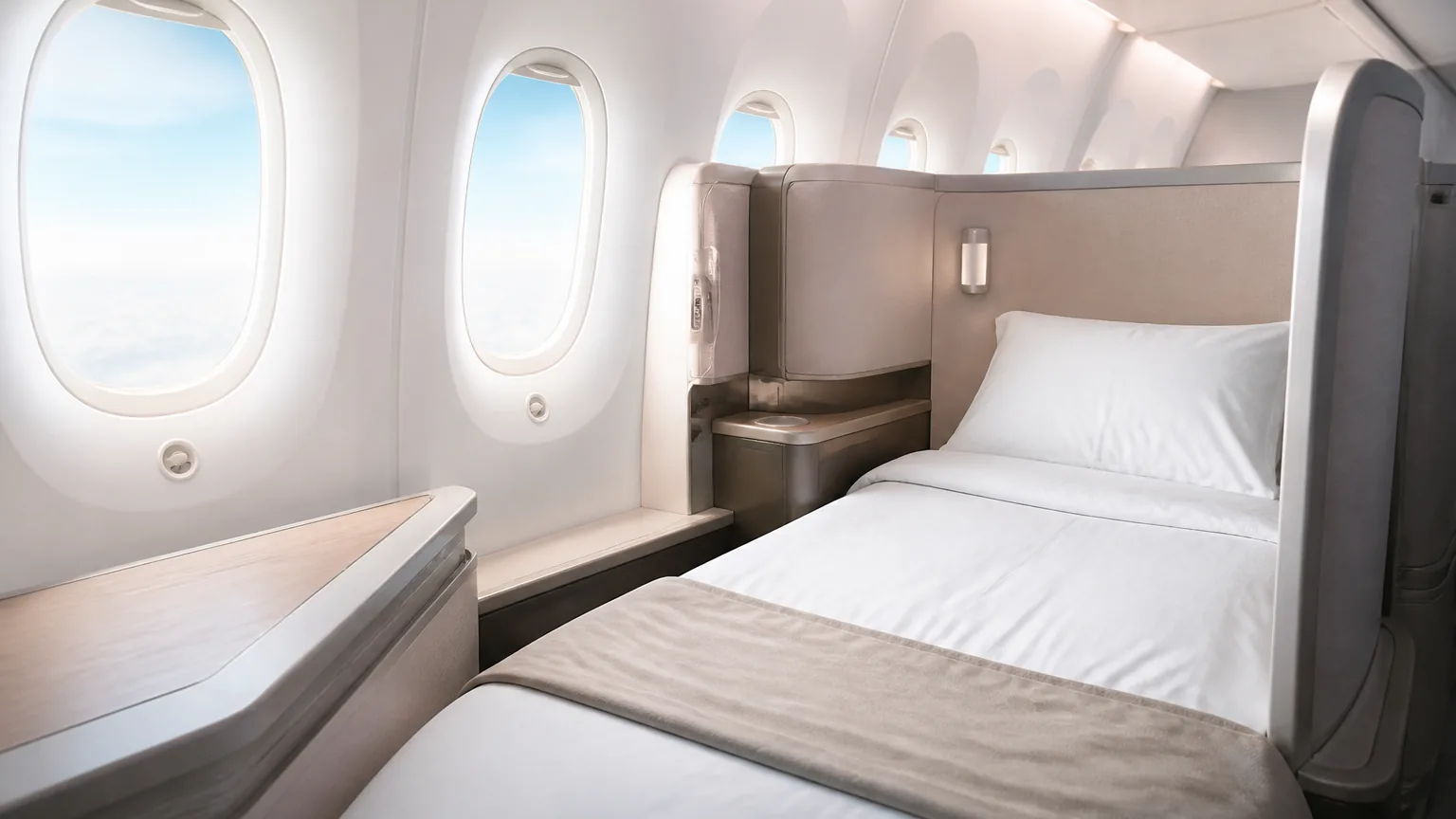
Business class on a long-haul route provides a flat bed on most modern aircraft. This eliminates the circulation issue and substantially improves the sleep opportunity — the most significant difference in the experience. Whether the cost premium (typically three to five times the economy fare) is justified depends on individual circumstances, health considerations, the length of the journey, and what the trip is for.
Premium economy — a genuine middle ground that has improved substantially at airlines including Emirates, Singapore Airlines, Cathay Pacific, British Airways, and Air France — provides a seat with meaningful additional space, a footrest, and a recline that allows some sleep on shorter long-haul routes. At roughly 40 to 60% of the business class fare, it represents a useful compromise for those who find flat-bed business class financially disproportionate to the trip being taken.
Economy on the better long-haul carriers has also improved. Airlines including ANA, Singapore Airlines, and Japan Airlines consistently rank highest for economy-class seat pitch, service quality, and food on long routes — worth considering when the choice of carrier is flexible.
Airport assistance
Meet-and-assist services — a staff member who meets travelers at check-in or the departure gate and guides them through security, passport control, and to the aircraft — are available at most international airports at no additional charge for those who need them, and at a modest fee for those who simply prefer them. These services are typically arranged through the airline at booking and can transform the airport experience from exhausting to orderly. The assistance categories in the booking system (W for wheelchair, WCHR for those who can walk but not long distances, WCHS for those who need assistance with stairs) are more specific than commonly known — it is worth reading the definitions and selecting the appropriate level rather than declining assistance because full wheelchair service isn't needed.
Circulation and health preparation
Compression garments — graduated compression socks and, on very long flights, compression tights — are widely recommended by travel medicine clinicians for flights over six hours. Their effectiveness in reducing lower-leg swelling and the associated discomfort on arrival is well documented, and the difference they make is something most users notice clearly after the first flight. The risk of a travel-related blood clot (DVT) rises with the length of a flight and with age past 40, according to the CDC, and a Cochrane review found that compression stockings substantially cut the risk of a symptomless clot on flights of four hours or more. Medical-grade rather than standard travel compression is generally recommended.
Hydration — consistently more than feels necessary, given that the aircraft cabin air is extremely dry — and deliberate movement (standing, walking the aisle, and leg exercises in the seat) every one to two hours are the approaches most consistently cited by travel medicine specialists as making a meaningful difference to how travelers feel on arrival.
Timing of sleep and light exposure on arrival, rather than on the departure time zone, is the most effective strategy for minimizing jet lag according to chronobiology research — with eastward travel generally requiring more adjustment time than westward. Some travel medicine clinics offer specific jet lag protocols for older travelers; these are worth considering for long eastward journeys.
What doesn't change
The anticipation. The moment of arrival in a new place. The photographs that will be looked at for decades. These don't diminish with age — and for many travelers, the perspective that comes with sixty or seventy years of living makes travel more meaningful than it was at thirty. The logistics are worth managing. The experience is worth having.
| Cabin class | What you actually get | Worth it when |
|---|---|---|
| Economy | A standard seat; extras cost more | Short daytime hops |
| Premium economy | More width and recline, priority boarding | The value choice for long hauls |
| Business | A lie-flat bed and lounge access | Overnight crossings where sleep matters |
| First | The most space and service | When the budget makes it easy |
To prepare for a long crossing, work in this order:
- Choose the cabin class by whether the flight is overnight and sleep matters.
- Book airport assistance in advance, even when it seems unnecessary.
- Prepare for circulation: move often, drink water, and ask the doctor about compression socks.
- Allow extra time at every step, since the logistics are what change with age, not the pleasure.
Key Takeaways
- Long-haul flying is harder on an older body — dehydration, poor circulation, and slower recovery from time-zone shifts — but each is manageable with preparation.
- A business-class flat bed removes the circulation problem and buys real sleep; premium economy is a useful middle ground at roughly 40 to 60% of the fare.
- Airport meet-and-assist services are free for those who need them, and the assistance codes are more specific than most travelers realize.
- Compression garments, steady hydration, and moving every one to two hours are the measures travel-medicine specialists cite most.
- Fight jet lag by shifting sleep and light to the arrival time zone, and expect eastward travel to take longer to adjust to.